What is a neodymium magnet?
What is a neodymium magnet?
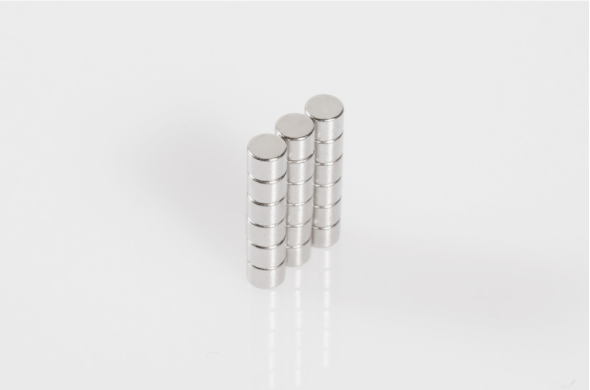
Neodymium magnets, also known as neodymium iron boron magnets, are tetragonal crystals composed of neodymium, iron, and boron (Nd2Fe14B). In 1982, Masato Sagawa of Special Metals Corporation discovered neodymium magnets. This magnet's magnetic energy product (BHmax) is greater than that of samarium cobalt. Magnet, its maximum magnetic energy product (BH), is more than 10 times that of a ferrite magnet. It was the most significant magnetic energy product globally at that time.
Later, it successfully developed a powder metallurgy process, and General Motors successfully developed a melt spinning process for preparing neodymium magnets. NdFeB has excellent mechanical processing properties, and the working temperature is as high as 200°C. This kind of magnet has stable performance and good cost performance. It is the most commonly used rare earth magnet used in electronic products, such as hard drives, mobile phones, earphones, and battery-powered tools.
The chemical composition of neodymium magnets
Neodymium iron boron magnet is a permanent magnet based on the intermetallic compound Nd2Fe14B. Its main components are the rare earth elements neodymium (Nd), iron (Fe), and boron (B). The third-generation rare earth permanent magnet neodymium iron boron is a contemporary magnet, The most powerful permanent magnet in the world. The main raw materials are neodymium 29%-32.5%, iron 63.95-68.65%, boron 1.1-1.2%, dysprosium 0.6-8%, niobium 0.3-0.5%, aluminum 0.3-0.5%, copper 0.05-0.15% and other elements.
Neodymium iron boron magnets are divided into sintered neodymium iron boron magnets and bonded neodymium iron boron magnets. Bonded neodymium magnets are magnetic in all directions and are corrosion-resistant. Sintered NdFeB is easy to corrode, and the surface needs to be electroplated, usually zinc, nickel, nickel, copper, nickel, etc. Sintered NdFeB magnets are generally divided into axial magnetization and radial magnetization. Sintered NdFeB permanent magnets have excellent magnetic properties and are widely used in electronics, motors, medical equipment, toys, packaging, hardware machinery, aerospace, and other fields.
What are the applications of neodymium magnets?
1. Electroacoustic field: speakers, microphones, alarms, stage audio, car audio, etc.
2. Electronic appliances: permanent magnet mechanism vacuum circuit breaker, magnetic holding relay, watt-hour meter, water meter, sound meter, reed switch, sensor, etc.
3. Motor field: VCM, CDDVD-ROM, generators, motors, servo motors, micro-motors, vibration motors, etc.
4. Mechanical equipment: magnetic separator, magnetic separator, magnetic crane, magnetic machinery, etc.
5. Medical care: nuclear magnetic resonance instrument, medical equipment, magnetic therapy health care products, magnetized fuel economizer, etc.
6. Other industries: magnetized anti-wax device, pipe descaler, magnetic fixture, automatic mahjong machine, magnetic lock, door and window magnet, stationery magnet, luggage magnet, leather magnet, toy magnet, tool magnet, craft gift packaging, etc.
in conclusion
Neodymium iron boron permanent magnet has the advantages of high magnetic energy product, coercivity, and high energy density. Neodymium iron boron magnet has a strong magnetic force and is currently the most magnetic material. They are widely used and cost-effective. NdFeB magnets have good mechanical properties and can be quickly processed into various shapes, including special-shaped magnets. The neodymium iron boron magnet has high precision, and the tolerance can be controlled within ±0.02mm.
评论
发表评论